
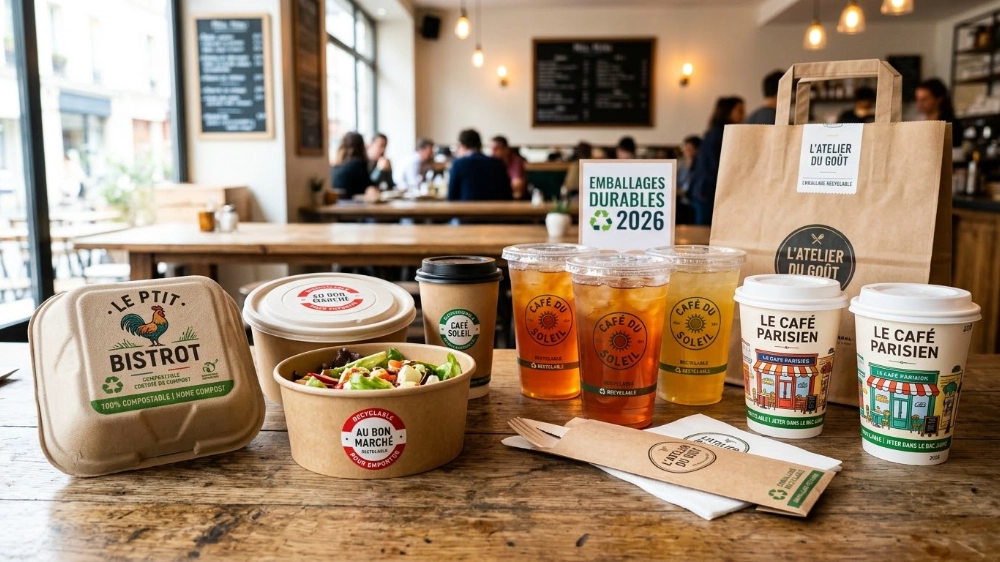
Restaurants are under growing pressure to reduce packaging waste, but choosing between compostable and recyclable packaging is not always straightforward. The right option depends on the food being served, packaging performance, local waste collection, and what happens to the package after use.
For many restaurants, the most practical choice is not simply the material with the “greenest” label. It is the one that works well and has a realistic end-of-life route.
Compostable vs Recyclable Packaging
.png)
Compostable Food Packaging
Compostable packaging is designed to break down under specific composting conditions. Some products are made for industrial composting, while others may be suitable for home composting.
The important point is that compostable does not mean the package will simply disappear after being thrown away. If it goes into a landfill or a waste stream that cannot process compostable materials, the expected environmental benefit may not be achieved.
Restaurants considering compostable packaging should check:
- Is the packaging certified for the intended type of composting?
- Does the local waste collection system accept it?
- Can food waste and packaging be separated properly?
- Does the waste contractor handle the complete package?
Without a suitable collection and processing system, switching to compostable packaging may not deliver the results a restaurant expects.
Recyclable Food Packaging
Recyclable packaging is designed to enter an appropriate recycling system. However, being technically recyclable does not guarantee that a package will actually be recycled.
Collection, sorting, and processing all matter. A package may also contain coatings, adhesives, printing inks, windows, or mixed materials that affect its recyclability.
For this reason, restaurants should look at the complete package rather than judging it by the main material alone.
Food Performance Still Comes First
Sustainability does not remove the basic job of food packaging: protecting the food.
Takeaway and delivery packaging may need to handle grease, sauces, moisture, heat, condensation, and pressure during transport. A burger box that becomes soggy or a container that leaks can damage the customer experience and potentially create unnecessary food waste.
Before choosing a material, restaurants should consider:
- Leak resistance
- Grease resistance
- Moisture resistance
- Heat resistance
- Stacking strength
- Ventilation
- Protection during delivery
A packaging material with strong environmental credentials is not necessarily the better choice if it cannot handle the food it is designed to carry.
Which Materials Make Sense?
There is no single material that works best for every restaurant.
Paper and paperboard are widely used for burger boxes, bakery packaging, takeaway meals, cups, and food trays. They offer good branding opportunities, but buyers should check coatings, grease resistance, moisture resistance, and other components.
PET and PP can be useful for cold drinks, salads, desserts, sauces, and other foods where strength, moisture resistance, or product visibility is important. Their end-of-life performance depends largely on the recycling infrastructure available in the target market.
PLA is a plant-based plastic often used for compostable foodservice packaging. It can work well where suitable composting facilities are available, but it should not automatically be considered a better version of conventional plastic. Its disposal route is different.
Molded fiber is another option for takeaway containers and trays. It can provide good stiffness and a natural appearance, but coatings, moisture resistance, food-contact requirements, and disposal options still need to be checked.
What Should Restaurants Check Before Buying?
.png)
Before placing a large packaging order, restaurant buyers should ask four practical questions.
1. What is the complete material structure?
Check the main material as well as coatings, linings, adhesives, inks, windows, lids, and other components. These details can affect both packaging performance and disposal.
2. Where will it go after use?
Find out whether the local recycling or composting system actually accepts the packaging. A theoretical environmental benefit is less useful if there is no practical collection route.
3. Can it handle the food?
Consider the actual operating conditions. Hot and greasy takeaway food has different requirements from cold drinks or bakery products. Packaging needs to provide the right balance of strength, moisture resistance, grease resistance, and ventilation.
4. Can the supplier provide documentation?
Ask for information about material composition, food-contact compliance, recyclability or compostability claims, certifications, coatings, and recommended disposal conditions.
Good documentation makes it easier to compare suppliers and avoid relying on vague environmental claims.
Which Should Restaurants Choose?
There is no universal winner between compostable and recyclable packaging.
For many takeaway applications, recyclable packaging can be a practical choice when an established recycling system is available. Compostable packaging can make sense when the local waste system can collect and process it correctly.
The better approach is to evaluate the whole packaging lifecycle: what the food requires, how the package performs, what it is made from, and what happens after the customer finishes the meal.
For restaurants, cafés, and foodservice businesses, the best packaging is not necessarily the one with the strongest environmental label. It is the one that protects the food, fits the operation, and has a realistic path after use.
