
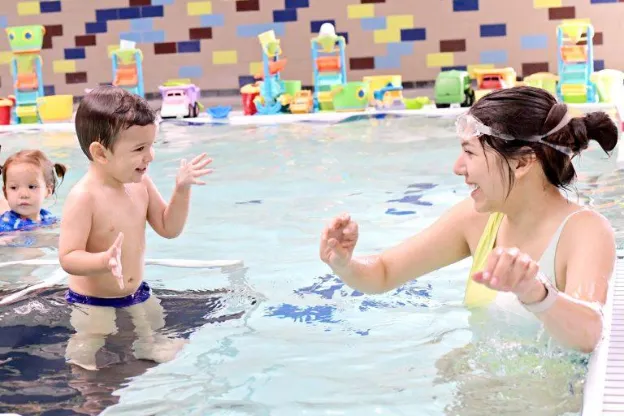
A three-month-old obviously isn’t learning freestyle. So why do so many pediatricians and parents push for swim lessons this early? It has almost nothing to do with actual swimming skill and almost everything to do with what’s happening in a baby’s brain and body while they’re in the water.
If you’ve been on the fence about starting early, swimming lessons for babies are built around this exact idea, using water as a tool for development, not just a place to eventually learn strokes.
Water Engages Muscles Differently Than Anything on Land
Babies spend most of their early months on their backs or bellies, working against gravity in a pretty limited range of motion. Water changes that completely. It supports their body weight while still creating resistance, which means a baby is working muscles they’d rarely engage during regular tummy time or play.
This resistance helps build core strength, which sounds minor but actually matters a lot for milestones like sitting up, crawling, and eventually walking. A stronger core means better balance and control once a baby starts moving independently on land.
It Supports Sensory Development
Babies are constantly taking in new sensory information, and water gives them a completely different set of inputs than anything they experience on dry land. The temperature, the pressure against their skin, the sound distortion underwater, and the sensation of buoyancy all stimulate the nervous system in ways that regular play simply doesn’t.
This kind of sensory variety is genuinely useful for early brain development. Babies who get more varied sensory experiences tend to process new information more easily as they grow, since their nervous systems have practice adapting to different environments.
Comfort in Water Reduces Fear Later On
Fear of water isn’t something babies are born with. It’s something that develops later if they don’t get positive, low-stress exposure early on. Babies who start in the water young and have consistently calm, supportive experiences tend to grow into toddlers and kids who are far more comfortable in pools, lakes, and even bathtubs.
This matters for safety more than people realize. A child who’s comfortable in water is less likely to panic if they unexpectedly fall in, and panic is what actually causes most drowning incidents, not lack of swimming ability alone. Building comfort early is one of the most overlooked water safety strategies parents have available to them.
The Parent-Child Bonding Piece Is Real
Baby swim classes almost always involve a parent or guardian in the water with the child, and that closeness does more than just keep the baby safe. Skin-to-skin contact, eye contact, and the physical closeness of holding a baby in water all support attachment in a similar way to other bonding activities like feeding or babywearing.
Some parents notice their baby is calmer and more responsive to them after a few weeks of consistent lessons, and that’s not a coincidence. The combination of physical closeness and a predictable, low-stress routine builds trust in a pretty direct way.
If you’re weighing different pool schools for this age group, ask specifically how involved parents are expected to be during class. Programs that treat baby swim as a shared parent-child activity tend to produce stronger comfort and bonding outcomes than ones that rush straight into independent skill-building.
It Builds Body Awareness Early
Water forces babies to become aware of their own body position in a way land-based activities don’t. Floating, being gently moved through the water, and reacting to buoyancy all require a level of body awareness that most babies aren’t developing yet through regular play.
This early body awareness tends to carry over into other physical milestones. Babies with more body awareness often show better coordination as toddlers, whether that’s climbing, running, or just navigating a room full of furniture without constantly bumping into things.
Routine Matters More Than People Expect
Babies thrive on predictability, and a weekly swim lesson creates a structured routine they start to recognize and even anticipate. Over time, many babies show clear excitement when they realize it’s swim day, kicking their legs or reaching toward the water before they’re even in it.
This kind of positive anticipation is a good sign. It means the water is being associated with comfort and enjoyment rather than stress, which sets a strong foundation for the more structured swim skills that come later as they move into toddler and preschool classes.
What to Actually Look for in a Baby Swim Program
Not every baby swim class is built the same way, and the differences matter more at this age than people assume. A good program should prioritize comfort and gradual exposure over rushing a baby toward independent movement. Instructors should be trained specifically in infant development, not just general swim instruction, since babies respond to touch, tone, and pacing very differently than older kids do.
Class size matters too. A smaller, more personal setting allows instructors to actually notice subtle cues, like a baby getting overstimulated or needing a break, that would get missed in a larger group. If you want more detail on what a class actually looks like for this age range, reach out to us and we can walk you through it.
Early Exposure Sets the Tone for Everything After
None of this is about producing a baby who can swim independently. That’s not realistic and isn’t the goal at this stage. What early lessons actually do is build comfort, strength, and body awareness that make every future stage of learning to swim easier and less stressful.
Parents who start early often notice their child moves through the more structured swim stages later on with less resistance and fewer fear-based setbacks, simply because water was never something unfamiliar or scary to begin with. That head start is worth more than any specific skill a baby could technically learn at this age.
It’s also worth remembering that progress at this stage isn’t linear, and that’s normal. Some weeks a baby seems completely at ease, kicking and reaching for the water on their own. Other weeks they might be fussier or more hesitant, often tied to growth spurts, teething, or just an off day. None of that means lessons aren’t working. It just means babies are still babies, and consistency over time matters far more than how any single class goes.
The real payoff shows up months and even years down the line, when a toddler who started young walks up to the pool edge without hesitation instead of clinging to a parent’s leg. That kind of ease doesn’t happen by accident. It’s built slowly, one calm, low-pressure lesson at a time.
